Saturday 3rd January 2026
The pick-up time we were given yesterday was 0900-0915, but we woke up to a new pick-up time of 0930-0945, oh good no rush, only to get another notification; a new pick-up time 0845-0900, so had to get our skates on!!! Today we are touring the Soweto area.
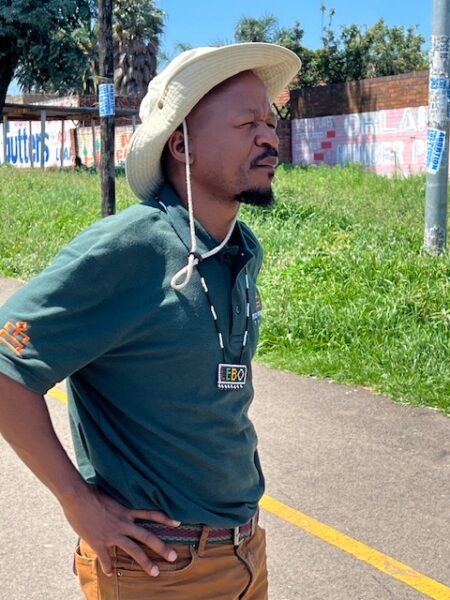
Fortunately we were sufficiently early enough to finish our breakfast and get to the lobby a few minutes before our guide arrived. We were his first pick-up then went to two other hotels so we were a party of 5. Our guide “Lebo” (also our driver), talked as we headed to Soweto on the history and background and how Johannesburg came-about following the discovery of gold. The drive was about 40-minutes but he stopped along the way to point things out. At one stop he pointed out a redundant a mine-shaft lift winding and a couple of kms later a “huge” pile of spoil, all excavated from that mine. He also explained how this spoil, much of it sand was still in place and not blown about or washed away; they had the forethought to grew grasses and other vegetation to bind it all together, and here it still stood. Later he pointed out a couple more redundant mine-lift windings but here the there was no pile of spoil, that had been removed and converted into a “theme park”. He also reminded us of Mahatma Gandhi (1869-1948) the Indian lawyer and anti-colonial nationalist who was also involved in South African politics and in gaining freedom. What I hadn’t appreciated was what was happening before Apartheid, and the depth of colonialism, racial discrimination and Afrikaner attitudes that led to “The National Party” getting elected in 1948 and formalising segregation. Gandhi left SA in 1914 once he’d achieved significant concessions for Indians living there.
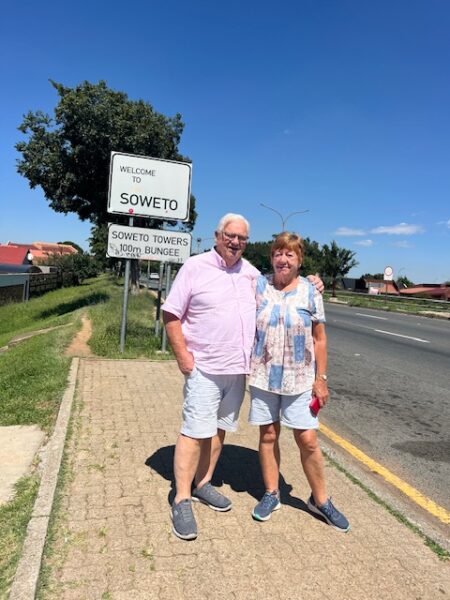
We arrived in Soweto and naturally stopped for photo opportunity. Soweto is a township in the municipality of Gauteng; now incorporated into the city of Johannesburg and borders the city’s mining belt in the south and first discovered by a George Harrison and George Walker in February 1886. Within a decade of the discovery of gold in this region,100,000 people of all races and nationalities flocked here in search of riches. As the area grew more and more, shacks and other shelters were erected everywhere until a number of Dutch settlers saw an opportunity and discovered clay along a stream which was suitable for brick-making, and started to produce building bricks locally and homes “popped” up everywhere.
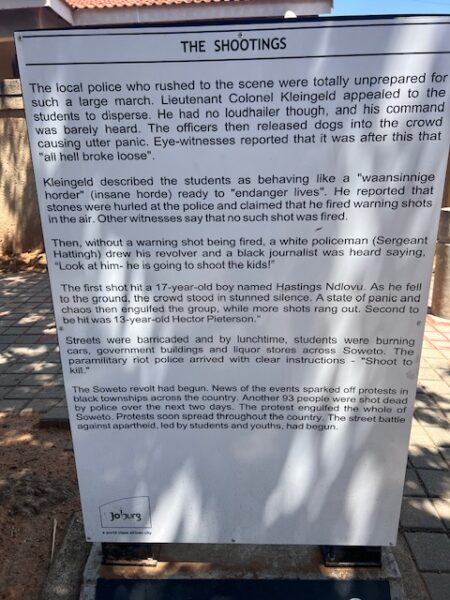
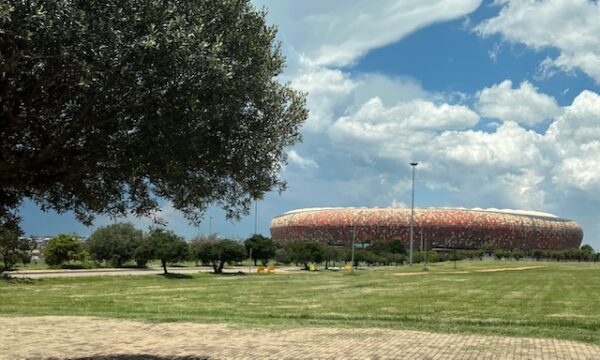
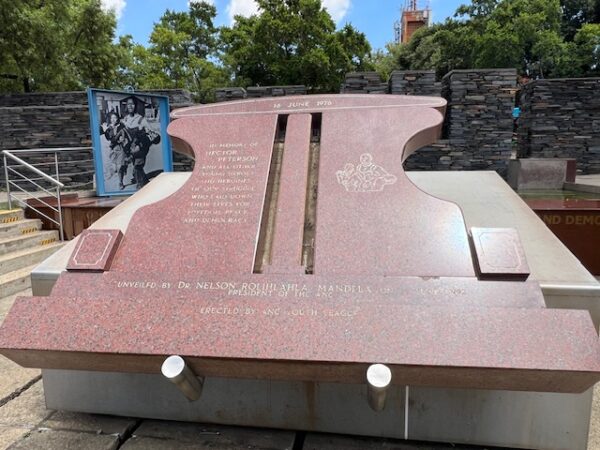
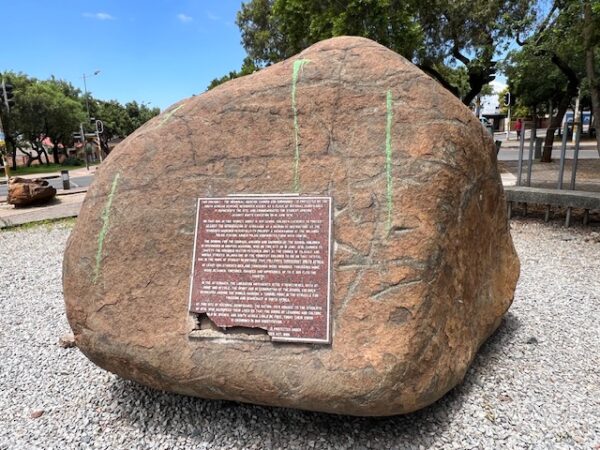
The “area” now “known” as Soweto was actually created in 1930’s when a white government started separating Blacks from Whites, to created “black townships”. Blacks were moved away from Johannesburg, to an area separated from white suburbs by a so-called “cordon sanitaire” (or sanitary corridor) which were usually either: a river, a railway track, an industrial area or a highway. It was in 1949 when SOWETO actually got its name, an acronym of “South West Townships” and the first time the name was used was in 1963 and within a short period of time, following the 1976 uprising of students (https://en.wikipedia.org/wiki/Soweto_uprising) in the township, the name became known internationally as 176 students were killed and over 1,000 injured as the riots were violently suppressed. Reforms followed, but riots flared up again in 1985 and continued until the first non-racial elections were held in April 1994. It was in 2010, that South Africa’s oldest township hosted the Football World Cup final, and the attention of more than a billion soccer spectators from all over the world, focused on Soweto.

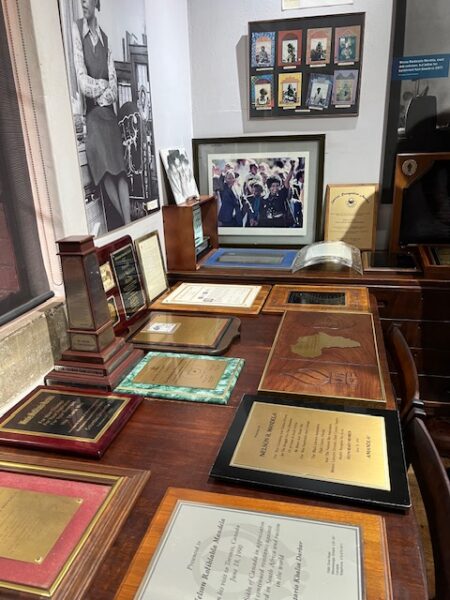
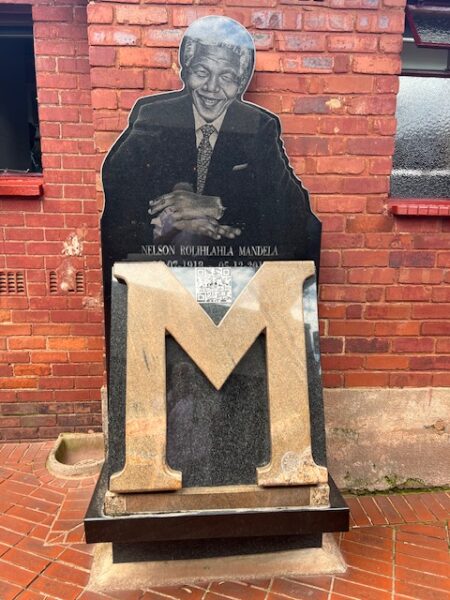
Whilst in the area, we naturally visited the “Mandela” museum, the house he spent most of his life, (other than when he was locked up), and lived there with two of his three wives and brought up his children. When we parked we were serenaded by a colourful local dance troop who naturally relied on tourists “tips”. We walked across the road ro a brick built house that had a communal room and two bedrooms, a shower and small kitchen. The roof was just corrugated iron so very hot in summer and b….y cold in winter. Also, though we didn’t visit it, down the road was the home of Desmond Tutu, later to be Archbishop of Cape Town who won the Nobel peace prize in 1984; Nelson Mandela won his Nobel Peace prize 1993 and as it has been pointed out several times, South Africa is the only country to have two Nobel recipients living in the same street!!!
Once we left the Mandela Museum we headed to Hector Pieterson square, named after one of the students killed by the over zealous authorities during the students riot in 1976, there is also a museum but unfortunately being a public holiday, it was closed.


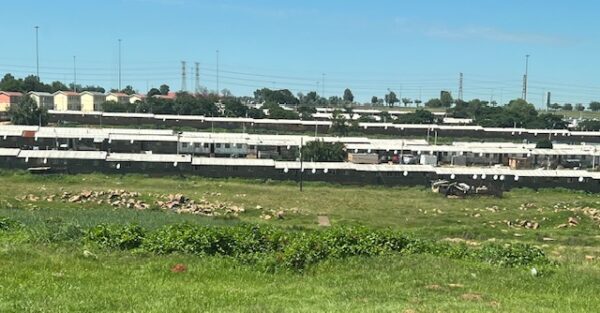
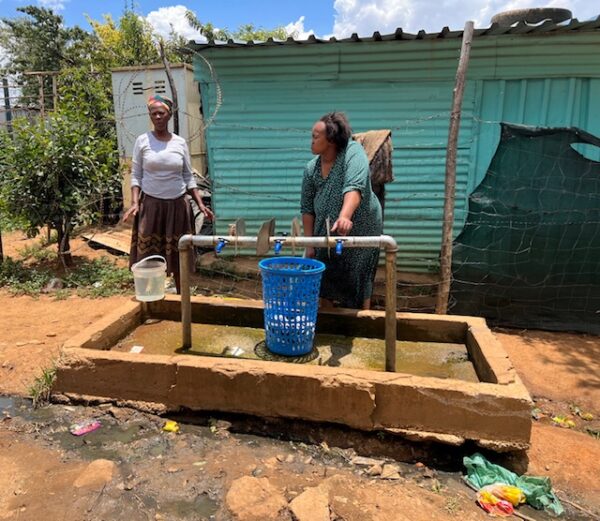
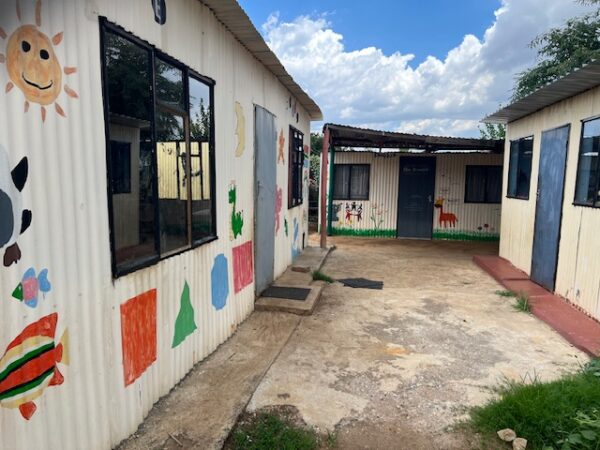
We now headed to the “poorest” area in SOWETO where there are dwellings made of everything from tin to wood to bricks, all crammed into a very tight area. Here our guide introduced us to a local lady who conducts short tours, explaining how things work in her community. It was rather interesting listening to her; we look around and see things through “western eyes”, but listening to her and their requirements, they had what they needed; a kindergarten for youngsters, buses laid on FOC by the state to take the older children to school, medical facilities within walking distance, running water and a community spirit, and they all seemed very happy: Who are we to judge??

It was time to head back, drop off the other three then us. Back at the Peach and knackered but hungry we headed to the restaurant for a late lunch. The food was great but the service was slow and the arrival of drinks seemed an eternity, still all very satisfying, we enjoyed it. We now headed for another early night.
Tomorrow we fly back home🥵🥵 with mixed feelings, we’ve had a great adventure but there so much more to do here, so going home is a bit “bitter-sweet”; we’ll just have to come back😁😄