
Thursday 19th March 2026
Not such a good night, probably not as tired as the night before; though we are on the 9th floor, this time we heard the “underground trains” rumbling through!!! No matter we had our objective and that was to get the Boston tour bus from the Boston common stop, a 25-minute walk.
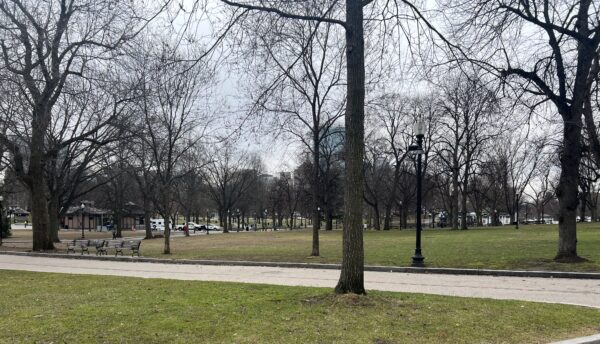
After another interesting breakfast we headed out, yes we could have got a train or cab etc., but decided to walk to take in the atmosphere and we walked through Chinatown, old Downtown and onto Boston Common where we headed straight into the Information centre to buy our two-day passes for the hop-on, hop-off buses. This office was at the bottom of the Boston common hill, the bus stop was at the top of the Boston common hill; that’s on top of the one + mile we had already walked!!!
Our stop was number 8 on the route so arrival times were quite dependant on traffic etc., but bus arrived around the appointed time and our decision was to stay on and do the whole tour. We would then decide where we wanted to stop off and what we wanted to visit. The whole tour took about two hours and again, was very informative but unlike the big red bus tours, where they give you earphones, here it was the driver who gave the commentary. As the day progressed and we changed buses with different drivers, so the commentaries changed. Not in the historical facts but pointing out different buildings, and reciting different facts; we suppose it boils down to their preferences.
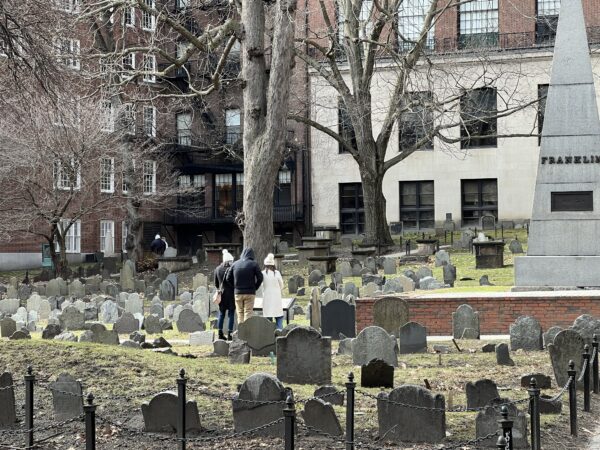
There are three historic cemeteries in the centre of old Boston dating back to the early puritans, who arrived in 1630 following their “disgust” and “religious persecution” back in England. Over the following 200-years, they filled their cemeteries, hence three, but the most significant is the Granary one I mentioned in my last post. The Granary cemetery, called this as it was adjacent to the towns granary store and was established in 1660. This is a historic cemetery famous for its Revolutionary War-era patriots, including Paul Revere, Samuel Adams, James Otis Jr, Robert Paine and John Hancock, as well as the victims of the Boston Massacre*. Other notable figures include Benjamin Franklin’s parents, nine Massachusetts governors, and the first mayor of Boston. This is a key stop on the Freedom Trail, known for its notable burials, unique headstone art, and apparently a site of local ghost stories. It has an estimated 5,000 people buried there under about 2,300 markers.
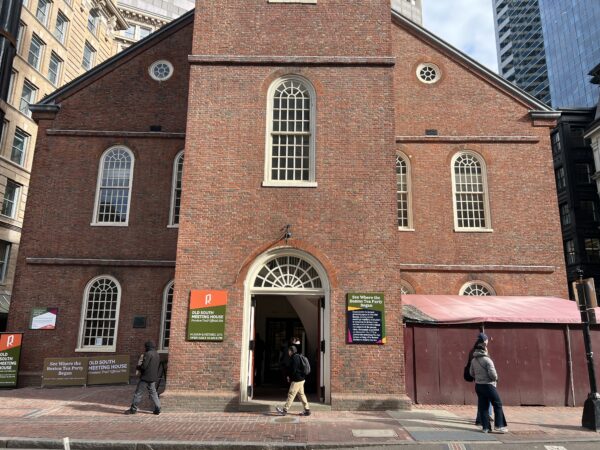
Another important site on the route is The old South Meeting house. This is a historic landmark and museum, famous as the site where the Boston Tea Party began in 1773, when thousands gathered to protest British taxation before heading to the harbour. Built in 1729, it was the largest building in colonial Boston and served as a crucial meeting place for public protests against British rule, making it a hotbed for the American Revolution. Today, it’s a museum operated by Revolutionary Spaces, featuring exhibits on its revolutionary history and serving as a symbol of free speech. It was in this meeting that James Otis spoke those famous words, “No Taxation without Representation” (allegedly).
On our first tour we changed to a different bus route that took us around the “Back Bay” area. This whole part of Boston is on re-claimed land, rather strange when you think of the size of the USA! The reason the council went ahead with this very expensive scheme was really due to blackmail. All the wealthy traders wanted to build nice properties but stay in the Boston area as well, so they threatened to leave and take their business with them, thus depriving the town of much needed local tax revenue. The result is the Back Bay Area, backing onto the Charles river. This tour also took us through theatre-land, here in Boston many of the Broadway shows are premiered to iron out any issues before it heads to NY.
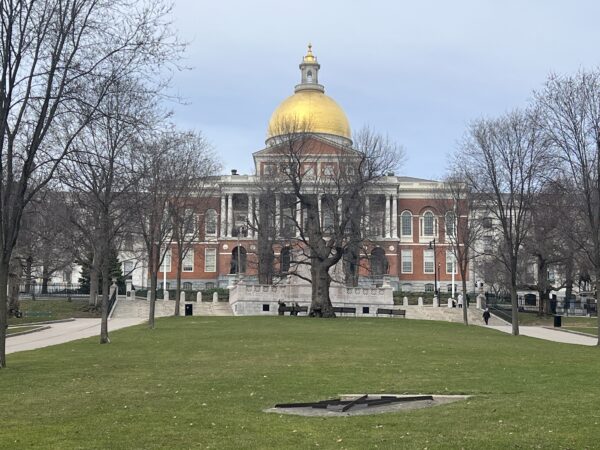
At the end of this we stopped for a little “nosh” and planned what we wanted to go and see/do. By now it was around 1400hrs and the last bus leaves stop one at 1600hrs and we didn’t fancy being stranded the other side of town so got back on the bus and headed to stop eight to look inside the “new” Massachusetts State House.
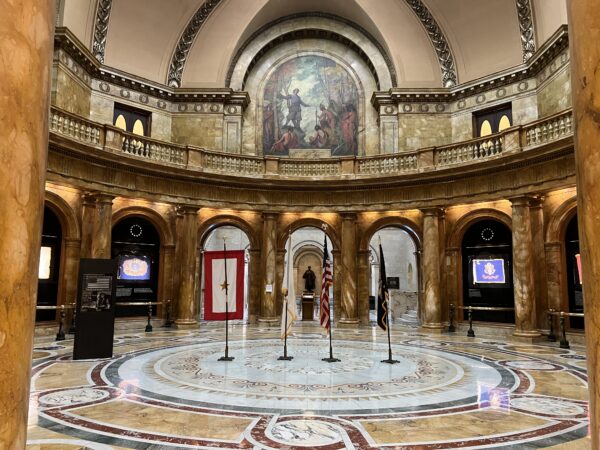
By the time we got off it was 1600hrs and the last bus at this stop was 1700hrs so we could only spend about 50-minutes inside. Fortunately the entrance is virtually opposite the bus stop.
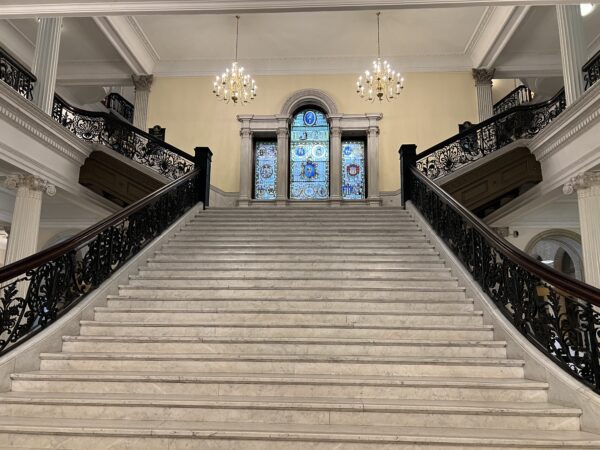
What a magnificent building. The Massachusetts State House in Boston is the seat of the state’s government, housing the Massachusetts General Court (legislature) and the Governor’s office, and is known for its distinctive gold dome covered in “gold leaf” and Federal architecture designed by Charles Bulfinch. the building is Located on Beacon Hill, at the top of Boston Common, it’s a historic landmark on the Freedom Trail, featuring numerous statues, murals, and art that reflect the state’s history, and is open to visitors, no entry charge!! The amount of marble inside is incredible, massive pillars, huge wide staircases beautifully decorated ceilings; one could spend a whole day here, but alas we had less than an hour👹.
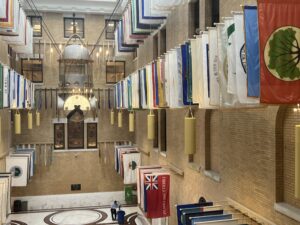
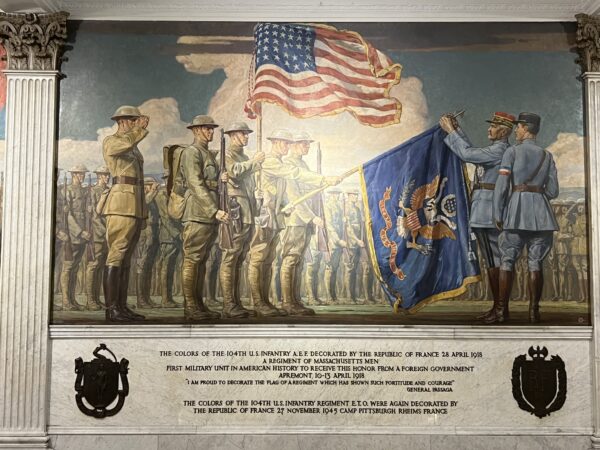
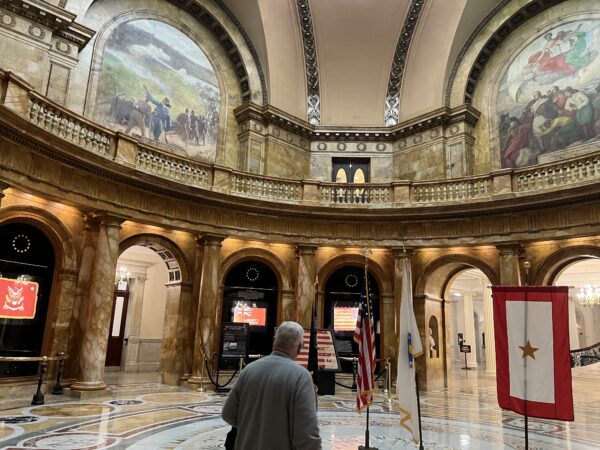
One intriguing area is Memorial Hall, also known as the Hall of Flags, it is a very big room that sits central to the state house’s second floor. The room displays regimental flags of returning Massachusetts soldiers from various regiments across “every” war since the Civil War, the stained glass skylight above contains the seals of the original thirteen colonies of the United States, with the Massachusetts seal in the centre; very spectacular.
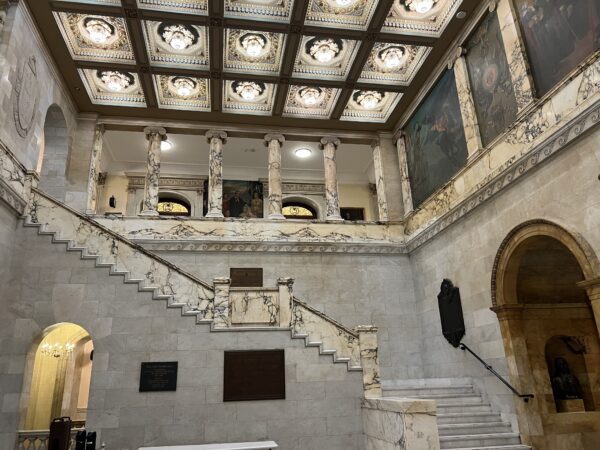
The inside of this building is enormous and we were totally disoriented and left via the wrong exit, we came out at the rear and now had to “hot-foot” it back to the bus stop and hope the bus hadn’t gone through! We stood waiting and wondering and then, out of the traffic we spotted it heading towards us, thank goodness as we didn’t want the long “march” back. We had discovered that stop nine was much closer to our hotel. There was only one other passenger and apparently she was heading back to the start point and whilst talking to the driver, he asked where we are staying. As we got to stop nine and as there were no passengers waiting to get on, he announced he’d take a detour and drop us even nearer our hotel, wow! And he did, what a kind driver, we hope we see him again tomorrow.
Back in our room we finished off the second part of last nights dinner and headed to bed later. Tomorrow we are planning to do the naval docks area and the tea party experience.
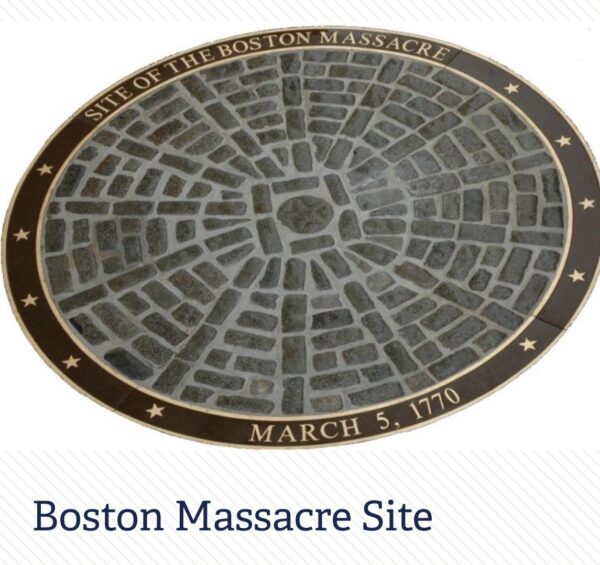
- The Boston Massacre, known in England as the Incident on King Street, was a confrontation on March 5, 1770 during the lead up to the American war of independence.
In this confrontation 9-British Soldiers shot several5 in the crowd, estimated to be between 300 & 400 who were harassing them verbally and throwing anything they could get their hands on. Five American colonists were killed. The event was subsequently described as a massacre by Samuel Adams and Paul Revere (see the etching below; Propaganda or what?) and other leading Patriots who later became central proponents of the revolution. British troops had been stationed in the Boston Bay Area since 1768 to support the Crown-appointed officials to enforce unpopular legislation imposed on them from the British Government
Amid tense relations between the civilians and the soldiers, a mob formed around a British sentry and verbally abused him. He was eventually supported by seven additional soldiers, led by Captain Thomas Preston, who were hit by clubs, stones, and snowballs. Eventually one soldier fired, possibly by accident, prompting the others to fire without an order by Preston. The gunfire instantly killed three people and wounded eight others, two of whom later died of their wounds.
The crowd eventually dispersed after the acting governor promised an inquiry, but they reformed the next day, prompting the withdrawal of the troops, Eight soldiers, one officer, and four civilians were arrested and charged with murder, and they were defended in court by attorney, and future U.S. president, John Adams, six of the soldiers were acquitted; the other two were convicted of manslaughter and sentenced to branding on the thumb, according to the law at that time.
The Bloody Massacre by Paul Revere: a 1770 engraving depicting the massacre